Steel metal pipe selection for fittings, pressure lines, and structures
What steel metal pipe usually means in fittings work
Steel metal pipe is a broad search term. In a working specification, however, it usually means a round steel product selected for a defined service: application, nominal pipe size, wall schedule or wall thickness, manufacturing route, material grade, end finish, and compatible fittings. The main decision is not only carbon steel versus stainless steel. It is whether the product will carry pressure, act as a structural member, serve as a water line, support equipment, or connect to threaded, welded, socket-weld, grooved, or flanged fittings. A pipe that looks right by diameter can still be wrong if the standard, wall thickness, coating, or end preparation does not match the fitting system.
For buyers, fabricators, and maintenance teams, the safest starting point is to define the service conditions first. Pressure, temperature, fluid, corrosion exposure, joining method, inspection level, and the applicable code all affect the final choice. For related hardware topics, see the Metal Fittings category.
Pipe, tube, and hollow section are not interchangeable
A common source of purchasing errors is treating pipe, tube, and structural hollow section as the same product. They can all be round and made of steel, but they are specified and used in different ways.
Pipe is normally used to convey fluids, gases, steam, air, or process media. It is commonly ordered by nominal pipe size, often called NPS, and by a wall designation such as schedule. ASME B36.10M standardizes dimensions for welded and seamless wrought steel pipe used at high or low temperatures and pressures. One important point from that standard is that pipe size is not always the measured outside diameter. For NPS 12 and smaller, the outside diameter is numerically larger than the nominal size. This is why fittings are matched to standard pipe dimensions rather than to a casual tape-measure reading.
Tube is often specified by actual outside diameter and wall thickness. It is common in mechanical, automotive, furniture, railing, heat exchanger, and precision fabrication work. Round structural tubing may look similar to pipe, but it is not automatically acceptable for pressure service.
Structural hollow section is selected for load-bearing work such as frames, columns, handrails, bridges, building supports, and equipment skids. ASTM A500/A500M, for example, covers cold-formed welded and seamless carbon steel structural tubing in round, square, rectangular, and special shapes for welded, riveted, or bolted construction and general structural use. That scope is different from pressure pipe specifications, so the end use must be clear before ordering.
Standards that shape pipe and fitting choices
Standards do not replace engineering judgment, but they give mills, distributors, fabricators, inspectors, and buyers a shared language for dimensions, manufacturing methods, tests, markings, and acceptable applications. A purchase description that only says steel pipe is incomplete. The standard named in the order defines the product family being requested.
Common pipe material specifications
ASTM A53/A53M is widely used for black and hot-dipped galvanized welded and seamless steel pipe. Public ASTM descriptions state that it covers NPS 1/8 to NPS 26 and includes Type F furnace-butt-welded, Type E electric-resistance-welded, and Type S seamless pipe. It is intended for mechanical and pressure applications and is also acceptable for ordinary uses in steam, water, gas, and air lines, subject to the limits of the standard and the project code.
ASTM A106/A106M is used for seamless carbon steel pipe for high-temperature service. Its scope covers NPS 1/8 to NPS 48, with dimensions referenced to ASME B36.10M. Because it is seamless and associated with elevated-temperature service, it is often considered when weld seam considerations, temperature, and process duty matter.
ASTM A312/A312M covers seamless, welded, and heavily cold-worked austenitic stainless steel pipe for high-temperature and general corrosive service. It is relevant when corrosion resistance or stainless grades such as TP304 or TP316 are part of the design requirement.
ASTM A500/A500M belongs in the structural category rather than the pressure-pipe category. The 2023 edition scope includes cold-formed welded and seamless carbon steel structural tubing with a periphery of 88 in. or less and specified wall thickness of 1.000 in. or less. This makes it useful for structural applications, but it should not be substituted for pressure pipe simply because the shape is round.
Dimensional and fitting standards
ASME B36.10M standardizes welded and seamless wrought steel pipe dimensions. In practice, this allows pipe, elbows, tees, reducers, flanges, valves, and other components to be selected around a shared dimensional system. ASME B36.19M serves a similar dimensional role for stainless steel pipe.
ASME B16.9 covers factory-made wrought buttwelding fittings in sizes NPS 1/2 through NPS 48, including dimensions, tolerances, ratings, testing, and markings. For a welded piping system, this standard helps ensure that elbows, tees, caps, and reducers match standardized pipe dimensions and can be integrated into a code-compliant design when all other requirements are satisfied.
For larger water infrastructure, AWWA C200-23 is listed by the American Water Works Association as steel water pipe for 6 in. and larger. That type of standard is more relevant to transmission, distribution, raw water, reclaimed water, wastewater, or utility systems than to small mechanical fittings.
How to match steel pipe to fittings
The fitting connection method is one of the fastest ways to narrow the correct pipe choice. A pipe may be dimensionally correct but still unsuitable if its wall is too thin for threading, its coating is damaged by welding, or its material does not match the fitting metallurgy.
Threaded and coupled connections
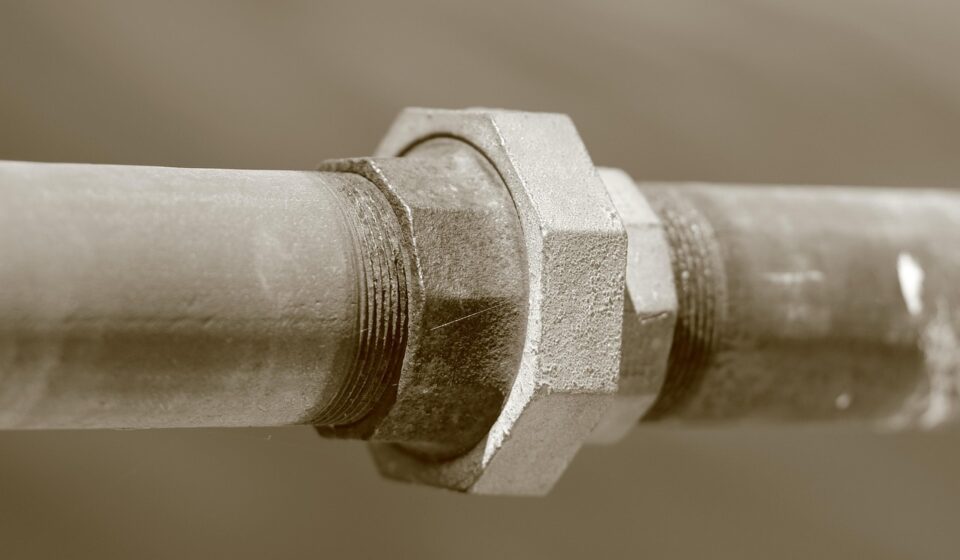
Threaded steel pipe is common in smaller mechanical and utility lines, but it requires enough wall thickness to cut threads without weakening the connection beyond acceptable limits. The thread form, sealant, assembly torque, and service pressure all matter. Galvanized threaded pipe is often used where zinc coating is desired, but cut threads expose steel unless corrosion protection at the joint is addressed by the system design or installation practice.
Threaded connections are relatively easy to assemble and maintain, but they are not suitable for every pressure, temperature, vibration, or hazardous-fluid application. The governing piping code and project specification should define where they are allowed.
Butt-weld, socket-weld, and flanged systems
Butt-weld fittings are selected when a continuous welded system is needed. Pipe ends are prepared for welding, and the fitting dimensions must align with the pipe outside diameter and wall thickness. This method can be strong and compact, but it requires qualified welding procedures, qualified welders, suitable inspection practices, and heat-control requirements appropriate to the material and service.
Socket-weld fittings are used in some smaller-bore systems. They simplify fit-up but still require the correct gap, welding, and inspection details. Flanged systems add bolted joints that can be opened for maintenance, but flange class, gasket material, bolting, facing, temperature, and pressure rating must all be compatible. The steel pipe is only one part of the joint system. See also: Buying Guides.
Grooved and mechanical couplings
Grooved couplings can speed installation and maintenance in fire protection, HVAC, and some utility systems. They depend on correct pipe outside diameter, groove geometry, wall thickness, gasket compatibility, and coupling rating. A grooved fitting catalog may list acceptable pipe types, but the project specification should still verify the fluid, temperature, movement, and support conditions.
Material and coating decisions
Steel pipe selection is usually a balance of strength, corrosion resistance, cost, availability, fabrication method, and inspection requirements. The following comparisons are useful at the early specification stage, but final selection should follow the applicable code and project design.
| Selection factor | Typical question | Why it matters |
|---|---|---|
| Carbon steel or stainless steel | Is corrosion resistance required, or are strength and cost the main drivers? | Carbon steel is common and economical, while stainless steel is selected when corrosion, hygiene, or temperature service justifies it. |
| Black or galvanized carbon steel | Will the pipe be exposed to moisture or ordinary atmospheric corrosion? | Galvanizing adds zinc coating, but cutting, threading, and welding can disturb that coating and may require repair methods. |
| Welded or seamless | Does the service, code, temperature, or purchaser requirement call for seamless pipe? | Some specifications permit both, while others require seamless construction for the duty. |
| Schedule or wall thickness | What pressure, temperature, corrosion allowance, threading, or mechanical load applies? | Wall thickness affects strength, internal diameter, weight, weld preparation, and fitting compatibility. |
| End finish | Will the connection be plain end, beveled, threaded, grooved, or coupled? | The end condition must match the chosen fitting and joining method. |
| Inspection and traceability | Does the project require test reports, heat numbers, nondestructive testing, or special marking? | Documentation is often as important as the pipe itself in regulated or engineered systems. |
Coatings deserve special attention. A galvanized steel metal pipe may be appropriate for some atmospheric or water-related exposures, but it is not a universal corrosion solution. Zinc coating behavior depends on environment, chemistry, temperature, contact with dissimilar metals, and damage during fabrication. Painting, lining, wrapping, stainless steel, or nonmetallic alternatives may be better in specific environments.
Stainless steel pipe also needs careful grade selection. A general reference to stainless is not enough because chloride exposure, cleaning chemicals, heat, weld procedures, and surface finish can affect performance. For example, TP304 and TP316 are both common austenitic stainless families, but they are not interchangeable in every corrosive environment.
A practical specification checklist
A clear order reduces substitution risk and rework. When preparing a request for quotation, bill of materials, or maintenance purchase, include these items whenever they are relevant:
- Application: pressure piping, structural support, mechanical guard, water line, gas line, drain, process line, or fabrication stock.
- Applicable standard and edition: for example, ASTM A53/A53M-24, ASTM A106/A106M-26, ASTM A312/A312M-25, ASTM A500/A500M-23, ASME B36.10M, or the project-specified alternative.
- Material grade or type: such as Grade B carbon steel, austenitic stainless grade, or structural tubing grade.
- Manufacturing route: welded, ERW, seamless, furnace-butt-welded, or another route allowed by the specification.
- Size system: NPS and schedule for pipe, or actual outside diameter and wall thickness for tube or hollow section.
- End finish: plain end, beveled end, threaded and coupled, grooved, or prepared for welding.
- Coating or surface condition: black, hot-dipped galvanized, pickled and passivated stainless, painted, lined, wrapped, or bare.
- Fitting interface: threaded fittings, ASME B16.9 buttweld fittings, flanges, mechanical couplings, hangers, clamps, or custom fabricated fittings.
- Documentation: mill test report, heat traceability, inspection certificates, coating certificates, or purchaser inspection requirements.
- Restrictions: no unapproved substitutions, no mixed standards, no unspecified coatings, and no undocumented material changes.
One useful rule is to specify the pipe and fitting together, not separately. For example, a buttweld elbow should match the pipe size, wall designation, material family, and service code. A structural clamp should match the outside diameter and load path, not simply the nominal pipe label. A threaded coupling should be evaluated with the pipe wall and thread requirement in mind.
Common mistakes to avoid
The first mistake is buying by outside diameter alone. Standard pipe dimensions, tube dimensions, and structural hollow sections may overlap, but they are governed by different assumptions. If the project calls for NPS pipe, use NPS and schedule or wall thickness rather than a loose measured diameter.
The second mistake is treating schedule as a pressure rating. Schedule indicates wall thickness within a size system. Actual pressure capability depends on material, temperature, joint type, corrosion allowance, design code, manufacturing standard, and installation quality.
The third mistake is assuming galvanized pipe can be welded without consequences. Welding can burn away zinc near the joint and may create safety and corrosion-control issues. If welding galvanized pipe is unavoidable, the procedure, ventilation, coating repair, and inspection requirements must be addressed before fabrication begins.
The fourth mistake is substituting structural tubing for pressure pipe. Round ASTM A500 tubing may be strong in a frame, but that does not make it a pressure-piping product. Conversely, pressure pipe may not be the most efficient member for a structural frame where flat faces, section properties, and connection details matter.
The fifth mistake is ignoring edition dates. Standards are revised over time. If a drawing, code, or purchase order names a specific edition, that edition controls unless the responsible engineer or authority approves a change.
Frequently asked questions
Is steel metal pipe the same as carbon steel pipe?
Not always. Steel metal pipe may refer to carbon steel, galvanized carbon steel, stainless steel, alloy steel, structural tubing, or ordinary steel pipe stock. Carbon steel pipe is one specific category within the broader steel pipe family.
Can the same fittings be used on different pipe schedules?
Sometimes, but not automatically. Many fittings match the standardized outside diameter of pipe, while wall thickness affects internal bore, weld preparation, pressure design, and connection strength. The fitting standard, pipe schedule, material, and service conditions must be checked together.
When should seamless steel pipe be specified?
Seamless pipe is often specified when the applicable standard, design code, temperature, pressure, purchaser requirement, or service risk calls for it. ASTM A106/A106M is a common seamless carbon steel pipe specification for high-temperature service, but final selection should follow the project design.
Is galvanized steel pipe corrosion proof?
No. Galvanizing provides zinc coating that can improve corrosion resistance in suitable environments, but it can be damaged by cutting, threading, welding, abrasion, or aggressive exposure. It should be treated as a coating system with limits, not permanent immunity.
What should be checked before ordering pipe for metal fittings?
Confirm the application, standard, grade, NPS or outside diameter, wall thickness, end finish, coating, fitting type, code requirements, and documentation. Most pipe-fitting problems come from missing one of those details rather than from the pipe material alone.