Metal tube clamp fittings explained for frames, railings and pipe supports
What metal tube clamp fittings are used for
Metal tube clamp fittings are mechanical connectors used to hold, join, brace or support round tube, pipe and similar cylindrical members without relying only on welding. In trade use, the same phrase can refer to two related but different product groups: structural clamp fittings for frames, handrails and guarding, and tube support clamps used to secure hydraulic, pneumatic, electrical or process lines to a base structure. The right choice depends less on the catalog name and more on five practical factors: tube outside diameter, load direction, vibration, corrosion exposure and the required inspection standard.
For buyers, fabricators and maintenance teams, the first step is to define what the fitting must do. A railing joint, a machine guard corner, a solar support frame and a hydraulic line clamp may all involve metal tube, but they do not solve the same engineering problem. This article focuses on selection criteria for industrial and construction-adjacent applications, while noting where a qualified engineer, local code requirement or project specification should take priority.
If you are comparing related hardware categories, the metal fittings section can help place tube clamps alongside brackets, couplings, plates and other connection components.
Structural tube clamp fittings and tube support clamps are not the same
A common specification error is using one general search term for two different functions. Structural tube clamp fittings are usually designed to connect tubes into a load-carrying arrangement. They may form a 90-degree corner, a tee, a cross, an adjustable angle, a base flange or a handrail joint. The tube often passes through or into a cast, forged or machined metal body and is held by set screws, bolts or clamping force.
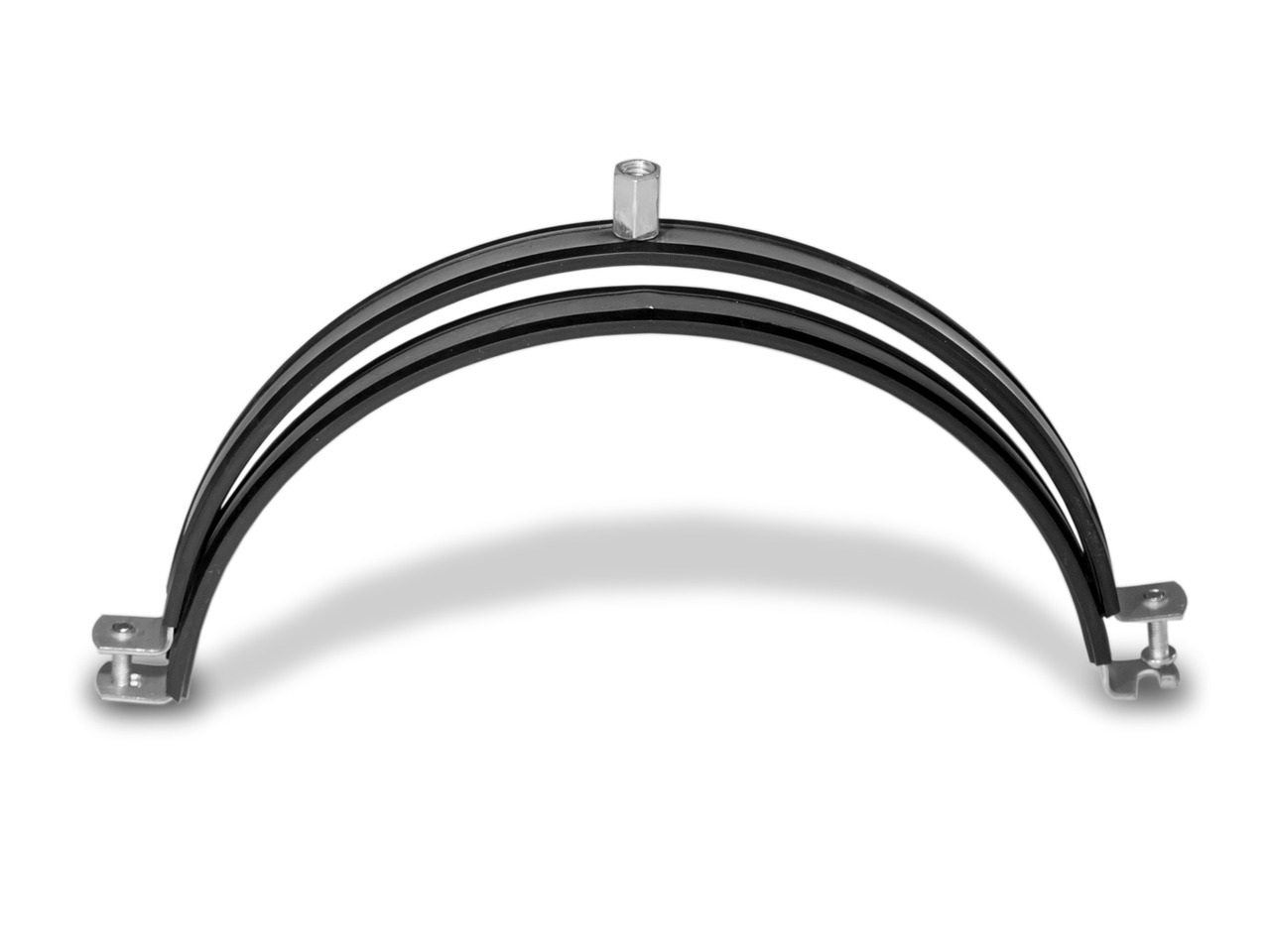
Tube support clamps are different. They are usually designed to restrain an individual tube, hose or pipe against a mounting rail, plate or channel. In hydraulic and fluid power systems, standardized clamp families such as DIN 3015 are widely referenced. Publicly available product literature from established fluid power suppliers commonly separates these into standard or light series, heavy series and twin series clamps. Their main purpose is support, alignment and vibration control, not the creation of a freestanding structural frame.
| Application type | Typical fitting role | Main selection concern | Common mistake |
|---|---|---|---|
| Guardrails and access platforms | Connect tubes into a barrier or handrail system | Load capacity, code compliance and joint security | Choosing by tube size only |
| Machine guards and frames | Create removable or adjustable frame joints | Rigidity, alignment and repeated assembly | Ignoring vibration loosening |
| Hydraulic and pneumatic lines | Hold tubes, pipes or hoses to a base | Clamp series, tube OD, spacing and vibration | Using a structural clamp as a line support |
| Outdoor frames and signage | Join tubes exposed to weather | Corrosion resistance and finish compatibility | Mixing metals without considering corrosion |
The five decisions that determine the right fitting
Start with the measured outside diameter
Tube clamp selection usually begins with outside diameter. This sounds simple, but it is where many mismatches start. Tube is commonly specified by measured outside diameter and wall thickness. Pipe is often ordered by nominal pipe size and schedule. A nominal pipe size does not necessarily equal the measured outside diameter, so a clamp described for a 1-inch tube may not fit a 1-inch nominal pipe unless the catalog explicitly states that it does.
For maintenance work, measure the existing tube or pipe with calipers rather than relying on a visual estimate. For new installations, record the tube OD, wall thickness, material grade and any coating thickness that could affect clamp fit. A galvanized coating, paint layer or polymer insert may be small, but tight clamp systems often have limited tolerance for accumulated dimensional changes.
Match the fitting to the load path
A clamp that performs well under a straight downward holding load may not perform the same under twisting, pull-out, side impact or cyclic vibration. Structural frames introduce bending and moment loads at joints. Line support clamps often deal with vibration, thermal expansion and occasional service movement. For a safety-related structure, catalog load values should be treated as one part of verification, not the full answer. The complete assembly, tube grade, fastener condition, spacing and installation quality all affect performance.
Decide whether adjustability or permanence matters more
Welded joints can provide rigidity, but they are harder to modify. Mechanical metal tube clamp fittings allow faster installation, field adjustment and disassembly. That makes them useful for temporary barriers, retrofit frames, machine guarding and modular workstations. The trade-off is that bolted or set-screw joints need correct torque, inspection access and a maintenance plan, especially in areas exposed to equipment vibration.
Consider whether the clamp must protect the tube surface
Some tube support clamps use plastic, elastomer or lined inserts to reduce metal-to-metal contact and vibration. Other structural fittings grip directly onto the tube. If appearance, paint integrity, stainless surface condition or hygiene is important, the contact surface matters. Over-tightening can mark softer metals, crush thin-wall tube or damage coatings. Under-tightening can allow slip, fretting or noise.
Material and finish choices affect service life
Most metal tube clamp fittings are made from carbon steel, galvanized steel, stainless steel, malleable iron, aluminum or zinc alloy, depending on the application and manufacturer. The material should match the environment and the consequence of failure. Indoor dry framing may not need the same corrosion resistance as coastal railing, washdown equipment or outdoor solar support structures.
Hot-dip galvanizing is a common protective finish for steel and iron fittings exposed to weather. ISO 1461:2022 is the international specification commonly cited for hot-dip galvanized coatings on fabricated iron and steel articles, while ASTM A123/A123M is often referenced in the United States for zinc hot-dip galvanized coatings on iron and steel products. These standards do not mean every galvanized fitting is automatically suitable for every environment. They define coating requirements and test methods; the project still needs an exposure assessment.
Stainless steel is often chosen where corrosion resistance, appearance or washdown performance is important. However, stainless grade selection should not be oversimplified. The British Stainless Steel Association notes that 316 stainless steels are widely used in marine applications but are not corrosion-proof in all seawater or splash-zone conditions, where pitting and crevice corrosion can occur. For chloride-rich locations, coastal air, swimming pool atmospheres or chemical cleaning, grade, surface finish and cleaning frequency all matter.
- Carbon steel: economical and strong, but it needs coating or controlled indoor conditions.
- Hot-dip galvanized steel or iron: suitable for many outdoor uses when coating quality and drainage details are appropriate.
- 304 stainless steel: useful for many indoor and mild outdoor environments, but not a universal marine choice.
- 316 stainless steel: often preferred for higher chloride exposure, though still subject to localized attack in severe conditions.
- Aluminum: lightweight and corrosion resistant in many settings, but it must be checked for galvanic compatibility and load limits.
Standards and codes should guide the specification
For noncritical furniture-style frames, the fitting catalog and a sensible design review may be enough. For guardrails, access platforms, industrial walkways and machinery safety barriers, requirements are more formal. In U.S. general industry workplaces, OSHA 29 CFR 1910.29 states that guardrail systems must be capable of withstanding a force of at least 200 pounds, or 890 newtons, applied downward or outward near the top edge. That requirement applies to the guardrail system, not merely to an individual fitting listed in isolation.
This distinction matters. A tube clamp fitting can be strong, but the assembled guardrail can still fail if posts are spaced too far apart, base plates are undersized, anchors are inadequate, tube wall thickness is too light or the installation is not inspected. For construction projects, local building codes, project specifications and safety standards may also apply. Where people could fall, be struck or be exposed to moving machinery, the selection should be reviewed as part of a complete system design.
For hydraulic and pipe support applications, DIN 3015-style clamp families provide a useful organizing language. Standard or light series clamps are commonly used for general tube and pipe support, heavy series clamps for higher mechanical loads or vibration, and twin series clamps where two parallel lines need support in a compact arrangement. The exact allowable load, spacing and material must still come from the manufacturer’s technical data and the project specification. See also: Buying Guides.
Installation details that change performance
Even a correctly selected fitting can underperform if it is installed poorly. The most important field checks are alignment, fastener condition, torque control, tube insertion depth and inspection access. Structural clamp fittings should not be forced into alignment by excessive tightening. If a joint only closes by bending the tube or twisting the fitting, the assembly may carry unintended stress from the first day of service.
Fastener quality is also important. Set screws and bolts should be the specified grade and material, not a convenient substitute from a general bin. Stainless fasteners in stainless bodies may need anti-galling practices. Galvanized components should be handled so coating damage is minimized, and cut tube ends should be protected where corrosion could start.
For tube support clamps, spacing affects vibration control and line life. Unsupported spans can allow whipping, resonance or fatigue, especially near pumps, compressors and moving equipment. Clamps should hold the tube securely without crushing it. Where thermal expansion is expected, the support design may need to allow guided movement rather than locking every point rigidly.
- Confirm tube or pipe outside diameter with a measuring tool.
- Check wall thickness and material grade against the fitting catalog.
- Identify all load directions, including impact and vibration.
- Select finish or stainless grade based on the actual environment.
- Use the specified fasteners and tightening method.
- Inspect the completed assembly, not just individual components.
Common specification mistakes to avoid
The first mistake is treating tube and pipe as interchangeable labels. A fitting that grips on outside diameter can be too loose or impossible to assemble if the wrong dimensional system is assumed. Always verify whether the catalog refers to tube OD, nominal pipe size, metric tube size or a proprietary system.
The second mistake is choosing by surface finish alone. A polished or stainless fitting may look more durable, but poor grade selection or trapped moisture can still lead to corrosion. Conversely, a galvanized fitting may perform well outdoors if the coating is intact, the design drains properly and the environment is not too aggressive.
The third mistake is using a clamp fitting outside its intended function. A hydraulic tube support clamp should not be treated as a structural frame connector. A modular railing clamp should not be assumed suitable for pressure-line vibration control. Similar appearance does not prove similar engineering purpose.
The fourth mistake is overlooking inspection and replacement. Mechanical connections are serviceable, which is an advantage, but only if they remain accessible. If a fitting will be hidden behind panels, buried inside equipment or coated after assembly, the maintenance plan should be decided before installation.
Frequently asked questions
Are metal tube clamp fittings stronger than welded joints?
Not automatically. Welded joints and mechanical clamp fittings behave differently. Welding can create a rigid permanent joint when properly designed and executed, while clamp fittings provide modularity and field adjustability. Strength depends on the fitting design, tube grade, fasteners, load direction and installation quality.
Can I use pipe clamps on tube?
Only if the clamp is sized for the actual outside diameter and intended service. Pipe sizes are often nominal, while tube sizes are usually based on measured outside diameter. Before ordering, confirm the dimension system used by the clamp manufacturer.
Which finish is better for outdoor tube clamps?
Hot-dip galvanizing is widely used for outdoor steel and iron fittings, while stainless steel may be preferred for appearance, washdown or chloride exposure. The better choice depends on moisture, salt, chemicals, maintenance access and compatibility with the connected tube.
Do guardrail tube clamp fittings need to meet OSHA requirements?
If the assembly is used as a workplace guardrail in the United States, the completed guardrail system should be evaluated against applicable OSHA criteria and any local or project-specific requirements. Individual fitting claims are not a substitute for checking the installed system.
What information should be included in a purchase request?
A useful request should include tube OD, wall thickness, tube material, application, load or service condition, indoor or outdoor exposure, preferred finish, required standard, drawing if available and any inspection or documentation requirement. Clear inputs reduce the risk of receiving a visually similar but unsuitable fitting.