How to choose drill accessories for metal, wood, masonry, and site work
Drill accessories should be chosen by material, tool type, and job risk
Drill accessories do more than fill out a toolbox. The bit, shank, arbor, guide, depth stop, lubricant, and dust-control attachment all affect whether a hole is clean, centered, safe, and repeatable. A basic twist bit may be enough for pine or mild steel. Stainless steel, concrete, tile, and large-diameter openings usually require more specific accessories and closer control of speed, heat, dust, and torque.
A practical selection process starts with the work material. From there, confirm the drill or driver connection, the hole diameter and depth, the expected heat load, and the safety controls required on site.
For more related hardware and jobsite tool topics, visit the Tools and Accessories section.
What counts as a drill accessory?
In trade use, drill accessories include any removable component that helps a drill, hammer drill, rotary hammer, or impact driver drill, bore, countersink, fasten, or finish a hole. The drill bit is the most visible accessory, but many problems blamed on the tool begin with the wrong supporting part.
Common drill accessories include:
- Twist drill bits for wood, plastic, and many metals.
- Masonry and concrete bits for brick, block, concrete, and stone.
- Spade, auger, Forstner, and brad-point bits for wood boring and cleaner entry holes.
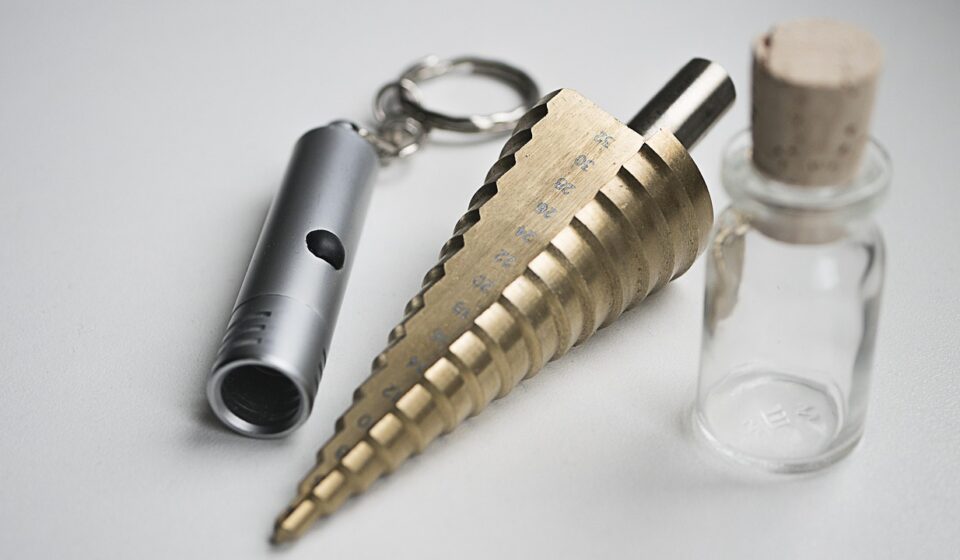
- Step bits for sheet metal, electrical boxes, and thin materials.
- Hole saws and arbors for larger circular openings.
- Countersinks and counterbores for flush screw heads and prepared fastener seats.
- Driver bits and bit holders for screwdriving with drills and impact drivers.
- Chuck adapters, quick-change holders, and extensions for reach and compatibility.
- Depth stops, drill guides, and right-angle attachments for repeatability and access.
- Lubricants, cutting fluids, dust extractors, and storage cases that support safer and more consistent work.
These parts should be treated as a system. A premium bit in the wrong chuck, a hole saw on an undersized arbor, or a masonry bit used without suitable dust control can still deliver poor results.
Match the accessory to the material first
The first selection question is not brand or price. It is the material being drilled. Wood, mild steel, stainless steel, aluminum, tile, brick, and reinforced concrete all load the cutting edge differently. They also create different chips, heat, vibration, and dust.
| Material | Useful drill accessories | Key selection note |
|---|---|---|
| Softwood and general lumber | Twist bits, brad-point bits, spade bits, auger bits, hole saws | Choose brad-point or Forstner bits where cleaner entry holes matter. |
| Plywood and laminates | Brad-point bits, Forstner bits, backing boards, drill guides | Support the exit side to reduce tear-out. |
| Mild steel | HSS or cobalt twist bits, step bits, cutting fluid, center punches | Use controlled speed and lubrication to manage heat. |
| Stainless steel and harder alloys | Cobalt or carbide-tipped bits, cutting fluid, rigid workholding | Heat control and feed pressure are critical to avoid work hardening. |
| Aluminum and soft nonferrous metals | Sharp HSS bits, step bits, deburring tools | Chip clearing matters because soft metals can clog flutes. |
| Brick, block, and concrete | Masonry bits, SDS-plus bits, carbide tips, dust extraction accessories | Match the bit shank to the hammer drill or rotary hammer system. |
| Tile and glass | Tile bits, diamond hole saws, water cooling where appropriate | Start slowly and avoid impact mode unless the accessory is designed for it. |
High-speed steel bits remain common for general drilling because they are affordable and versatile. Cobalt alloy bits are often selected for tougher metals because they handle heat better than standard HSS, although they can be more brittle. Carbide-tipped and solid-carbide accessories are used where abrasion resistance and edge retention are important, including masonry, tile, composites, and difficult metals. This is why a general-purpose bit set can be useful for maintenance work but may not be enough for repeated production drilling.
Confirm shank and chuck compatibility before drilling
The shank is the part of the accessory held by the tool. If the shank and chuck do not match, the accessory may slip, wobble, eject, or fail to transfer impact energy correctly. This is a common compatibility issue when accessories are shared across standard drills, impact drivers, hammer drills, and rotary hammers.
Round and reduced shanks
Round shank twist bits are common in keyed and keyless drill chucks. A reduced shank allows a larger-diameter bit to fit into a smaller chuck, but the operator still needs to respect the drill’s power, speed range, and safe operating capacity. If a bit fits the chuck, that does not automatically mean the tool is suitable for the hole size.
Hex shanks and quick-change holders
Quarter-inch hex shanks are common on driver bits and many quick-change drill accessories. They are useful where fast changeover matters, especially when switching between pilot drilling and screwdriving. Accessories used in impact drivers should be impact-rated when the tool applies hammering torque. A standard bit may fit physically but still be unsuitable for impact loading.
SDS-plus and SDS-max systems
Rotary hammers commonly use SDS-style shanks instead of a standard three-jaw chuck. SDS-plus accessories are widely used for smaller and medium holes in concrete and masonry, while SDS-max is associated with heavier rotary hammer work. The benefit is not only retention. The shank design helps transmit hammer energy to the bit, so using the correct SDS accessory is a performance and safety issue, not just a convenience.
Choose the right accessory group for the hole type
Different holes require different accessories, even in the same material. A clean pilot hole, a clearance hole, a countersunk screw hole, and a pipe opening each have different geometry and different cutting demands.
Twist bits for general holes
Twist bits are the general-purpose choice for many materials. For metal, point geometry, coating, flute design, and cutting fluid become more important as the material gets harder. A center punch or spotting drill can help prevent the bit from wandering on metal surfaces, especially when accuracy matters.
Brad-point, Forstner, spade, and auger bits for wood
Wood drilling benefits from accessories that control entry and clear chips efficiently. Brad-point bits help locate the hole cleanly. Forstner bits are useful for flat-bottom holes and cleaner larger diameters. Spade bits remove material quickly but usually leave a rougher finish. Auger bits are useful for deeper holes because the screw point and flute form help pull chips out.
Step bits for sheet materials
Step bits are practical for thin metal and plastic because one accessory can produce several hole sizes. They also tend to cut rounder holes in sheet material than forcing a large twist bit through thin stock. They are less suitable for thick plate because each step has limited cutting depth.
Hole saws for large openings
Hole saw performance depends on the saw body, tooth material, pilot bit, and arbor. The arbor must match the hole saw thread and the drill chuck. Large hole saws create more torque reaction than small bits, so side handles, stable footing, and correct speed are important. When cutting metal, lubricant and controlled pressure help reduce heat and tooth wear.
Countersinks and counterbores for fasteners
A countersink is not only cosmetic. It helps the fastener head sit flush and can reduce splitting in wood when used with an appropriate pilot hole. Counterbores create a flat-bottom recess for socket head screws, plugs, or washers. These accessories are especially useful in cabinetry, metal fabrication, and fixture installation. See also: Buying Guides.
Heat, dust, and accuracy decide whether accessories last
Many drill accessory failures are caused by operating conditions rather than manufacturing defects. Excessive speed in metal creates heat that can soften cutting edges and discolor or dull the bit. Too little feed can make the bit rub instead of cut. Too much pressure can snap small bits or overload the drill. In masonry, dust buildup in the hole can slow cutting and increase wear. In wood, poor chip removal can cause burning and wandering.
Three supporting accessories can make a clear difference:
- Cutting fluid or lubricant helps manage heat and friction in many metal drilling tasks. It is especially helpful for repeated holes or harder alloys.
- Depth stops and collars improve repeatability when drilling shelf pin holes, anchors, hardware holes, and pilot holes where breakthrough would damage the work.
- Drill guides and bushings improve alignment when a handheld drill needs to start square or repeat a pattern.
Dust control deserves special attention. Drilling concrete, masonry, fiber cement, and some engineered materials can release fine dust that is more than a cleanup problem. OSHA rules in the United States require appropriate eye or face protection where employees are exposed to flying particles, and NIOSH guidance emphasizes selecting eye protection based on the hazard and work situation. For silica-containing materials, contractors should also consider applicable dust-control rules, local regulations, and the tool manufacturer’s instructions for shrouds or extraction attachments.
How to build a practical drill accessory kit
A useful kit should match the work actually performed. A maintenance technician, metal fabricator, cabinet installer, electrician, plumber, and concrete anchor installer will not need the same mix. The following structure suits many general hardware and site teams.
Core accessories for mixed maintenance work
- HSS twist bit set for wood, plastic, and mild metal.
- Brad-point wood bit set for cleaner holes in visible surfaces.
- Masonry bit set for brick and block, matched to the drill type.
- Impact-rated driver bit set with magnetic or locking holder.
- Countersink bit for screw preparation.
- Small step bit for sheet metal and electrical boxes.
- Center punch, deburring tool, and cutting fluid.
- Depth stop collars and a compact drill guide.
Added accessories for heavier site work
- SDS-plus or SDS-max bits matched to the rotary hammer.
- Carbide-tipped masonry bits for repeated anchor holes.
- Hole saw kit with correct arbors and replacement pilot bits.
- Right-angle drill attachment for joist bays, cabinets, and tight framing.
- Dust shroud or extraction attachment where masonry dust is expected.
- Bit extensions rated for the intended torque and application.
Storage is part of the system. Bits that rub together in a loose box can become dull before they are used. Labeled cases, size indexes, and separate storage for metal, wood, masonry, and driver accessories reduce time lost on site and make it easier to replace worn items before they fail.
Common mistakes when buying or using drill accessories
The most common mistake is buying a large set because it looks complete while ignoring whether the accessories fit the tool and the material. A 100-piece set may still lack a good masonry bit, a quality countersink, or the correct hole saw arbor. Another mistake is using an impact driver as a substitute for every drilling task. Impact drivers are useful, but not every drill bit is designed for impact torque.
Speed is another frequent issue. Large bits and hole saws usually need slower speeds than small bits. Stainless steel and harder metals require patience, lubrication, and steady feed. Masonry drilling requires the correct hammer action and bit type. Tile and glass require a different approach again, often with low speed, careful starting, and cooling.
Finally, worn accessories should be treated as consumables. A dull bit increases heat, requires more pressure, damages the workpiece, and raises the chance of slipping. Replacing a low-cost bit is usually cheaper than damaging a panel, breaking a fastener, enlarging an anchor hole, or overloading a drill.
Frequently asked questions
Are drill accessories universal?
No. Some accessories are broadly compatible, such as many round-shank bits used in three-jaw chucks, but shank type, chuck size, torque load, impact rating, and tool mode all matter. Always match the accessory to the drill, driver, hammer drill, or rotary hammer being used.
Can masonry bits be used in a regular drill?
Some masonry bits can physically be used in a regular drill for light work in soft brick or block, but performance is limited without hammer action. Concrete and repeated anchor holes usually call for a hammer drill or rotary hammer with compatible masonry or SDS accessories.
When should a step bit be used instead of a twist bit?
A step bit is useful for thin sheet metal, plastic boxes, and panels where multiple hole sizes may be needed. It is not the first choice for deep holes or thick plate because the stepped cutting edges have limited depth.
Do impact-rated bits matter?
Yes, when using an impact driver. Impact-rated accessories are designed for the torsional loading of impact tools. A standard accessory may fit the chuck but can wear faster or break under impact use.
What is the simplest way to improve drilling accuracy?
Mark the hole clearly, use a center punch or pilot hole where appropriate, keep the drill square, select the right bit geometry, and use a guide or bushing when repeatability matters. Accuracy usually improves more from setup and accessory choice than from force.
Key takeaway
The right drill accessories are selected from the workpiece outward: material, hole type, shank system, tool mode, heat control, dust control, and accuracy requirements. A smaller, well-matched accessory kit will usually outperform a large mixed set that ignores compatibility. For hardware buyers and site teams, the most reliable approach is to stock core accessories by application, replace dull consumables early, and treat safety accessories as part of the drilling system rather than an afterthought.