How to choose grinding tools for metalworking and surface preparation
Grinding tools start with the job, not the catalog
Grinding tools remove material by using abrasive grains as many small cutting edges. The right choice depends on the workpiece material, the amount of stock to remove, the finish required, the machine in use and the safety limits marked on the tool. A wheel that performs well for heavy weld cleanup on mild steel may be unsuitable for carbide, glass, stainless steel or precision tool grinding.
For most workshops, the selection process should start with the operation. Define the task, match the abrasive to the material, choose a bond and shape that fit the machine, then check dimensions, bore size, speed rating, guarding and storage condition before use. Standards and safety guidance from OSHA, ISO and abrasive industry bodies treat grinding performance and safe operation as connected issues, not separate checks.
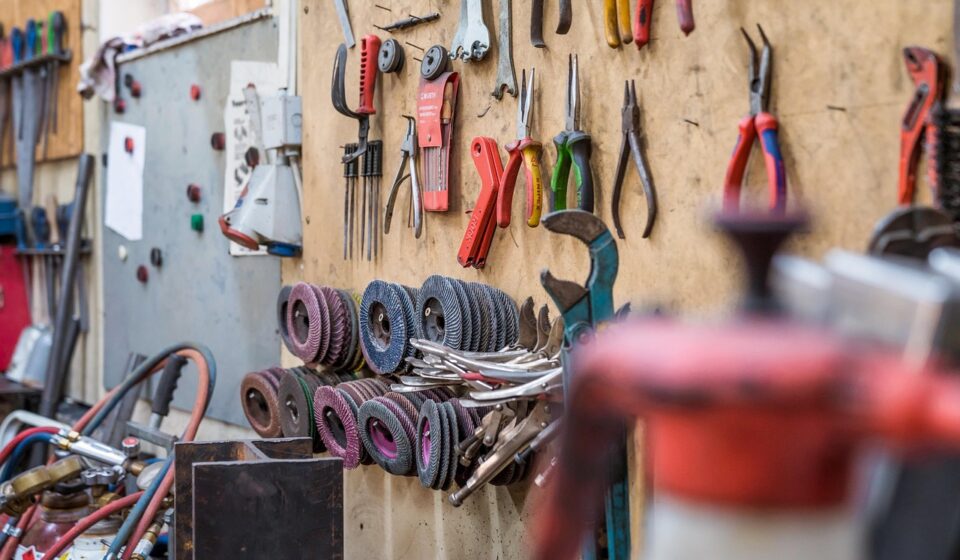
This guide covers common grinding wheels, flap discs, mounted points, sharpening stones, diamond tools and CBN tools used in metalworking, fabrication, repair and surface preparation. For more related hardware topics, see the tools and accessories section.
Main types of grinding tools and where they fit
The phrase “grinding tools” covers several product families. They are not interchangeable, even if they fit the same grinder spindle. Tool geometry, abrasive type and bond construction determine whether a product is suitable for cutting, grinding, deburring, sharpening, finishing or precision form holding.
| Tool type | Typical use | Common machine | Key selection factor |
|---|---|---|---|
| Bonded grinding wheel | Bench grinding, surface grinding, cylindrical grinding, toolroom work | Bench grinder, pedestal grinder, surface grinder, CNC grinder | Wheel shape, grain, grade, structure and bond |
| Depressed-center grinding wheel | Weld grinding, edge cleanup, stock removal | Angle grinder | Diameter, thickness, RPM rating and wheel type |
| Flap disc | Blending, finishing and light grinding | Angle grinder | Grit size, backing shape and abrasive cloth type |
| Mounted point | Small-area deburring, die work and internal features | Die grinder or rotary tool | Head shape, shank size and maximum speed |
| Grinding stone or dressing stick | Sharpening, hand finishing or wheel conditioning | Manual use or grinder accessory | Abrasive hardness and intended material |
| Diamond or CBN wheel | Hard materials, carbide, ceramics, hardened steel and precision tool grinding | Tool grinder, surface grinder, CNC grinder | Superabrasive type, bond system and coolant conditions |
Bonded abrasive products include grinding wheels, segments, sticks and stones. ISO 525:2020 covers shape types, designation and marking for bonded abrasive products, while ISO 603 standards address dimensions for specific bonded wheel families. For example, ISO 603-14:2022 covers common bonded wheel shapes used for deburring and fettling on angle grinders, including depressed-center grinding wheels.
Match the abrasive grain to the workpiece material
Abrasive grain is the cutting material inside the grinding tool. It affects cutting speed, heat generation, surface finish and tool life. The most common choices are aluminum oxide, silicon carbide, ceramic alumina, diamond and cubic boron nitride, usually called CBN.
Aluminum oxide for general steel work
Aluminum oxide is widely used for carbon steel, alloy steel and general-purpose metal grinding. It is common in bench wheels, grinding discs, mounted points and sharpening stones. It is a practical choice when the job involves ordinary ferrous metals and the priority is reliable stock removal rather than maximum wheel life.
Ceramic alumina for tougher steel applications
Ceramic alumina is engineered to fracture in a controlled way, exposing fresh cutting edges during use. It is often selected for more demanding steel grinding, stainless steel fabrication or production work where heat control and sustained cutting matter. It normally costs more than conventional aluminum oxide, so the choice should be justified by higher productivity, cooler cutting or longer usable life.
Silicon carbide for non-ferrous and brittle materials
Silicon carbide is harder and sharper than conventional aluminum oxide, but it is also more friable. It is commonly used for cast iron, non-ferrous metals, stone, glass and certain hard brittle materials. It can cut aggressively, but it is not automatically the right choice for every steel job because its grain fracture and heat behavior differ from aluminum oxide products.
Diamond and CBN for hard or specialized materials
Diamond and CBN are superabrasives. Diamond is used for carbide, ceramics, glass, stone and other very hard non-ferrous materials. CBN is generally associated with hardened ferrous materials because it withstands grinding conditions that are unsuitable for diamond on steel. Industry associations such as FEPA group abrasives into bonded abrasives, coated abrasives, abrasive grains and superabrasives, reflecting major differences in construction and application.
Understand bond, grade and grit before buying
Two grinding tools with the same diameter and grit number can behave very differently. Bond type, grade and structure control how abrasive grains are held, released and exposed during grinding.
Bond controls how the tool wears
The bond is the material that holds the abrasive grain in the tool. Vitrified bonds are common in precision and bench grinding because they are rigid, porous and dressable. Resin bonds are used in many portable grinding wheels and some superabrasive tools because they can provide a strong, relatively shock-resistant structure. Metal bonds are valued in some diamond and CBN tools for wear resistance and form retention. Electroplated tools hold abrasive in a plated layer and are often used where a specific profile or aggressive cutting action is needed.
Grade is not the same as abrasive hardness
Wheel grade describes how strongly the bond holds the abrasive grains. It should not be confused with the hardness of the abrasive itself. A softer grade releases dull grains more readily, which can help on hard materials or wide contact areas. A harder grade holds grains longer, which can help on softer materials or narrow contact areas. If a wheel glazes, burns the workpiece or stops cutting freely, the grade, speed, feed, dressing method or coolant condition may be wrong.
Grit size affects both removal rate and finish
Coarser grits remove material faster and leave a rougher finish. Finer grits improve surface finish, but they can load, glaze or overheat if used for heavy stock removal. A practical workflow is to rough grind with a coarser tool, then step down to finer abrasive products for blending or finishing. Skipping too many grit stages usually increases grinding time rather than reducing it.
Choose the shape for the machine and operation
Grinding tool shape is not just a matter of convenience. It affects contact area, side loading, guard fit, operator control and whether the tool is being used as designed.
- Straight wheels are common on bench grinders, surface grinders and cylindrical grinders.
- Cup wheels are used for face grinding, tool grinding and some surface preparation tasks.
- Depressed-center wheels fit angle grinders and allow clearance between the work surface and the mounting hardware.
- Flap discs combine coated abrasive flaps with a backing plate for blending and lighter grinding.
- Mounted points handle small internal radii, grooves, castings and die work.
- Diamond cup wheels are widely used for concrete, stone and masonry surface preparation.
ISO 603-14:2022 identifies shape types such as straight cup, taper cup and depressed-center wheels for hand-held angle grinder deburring and fettling applications. That matters because a wheel’s geometry is part of its intended use. A cutting wheel should not be treated as a general side-grinding wheel unless the manufacturer specifically marks it for that use.
Check speed, fit and safety markings every time
Grinding tools store rotational energy, and a damaged or oversped abrasive wheel can fail violently. Selection should always include a safety check before the tool reaches the workpiece.
OSHA’s abrasive wheel machinery standard, 29 CFR 1910.215, requires abrasive wheels to be used on machines with safety guards except for limited listed cases. It also states that wheels should be inspected immediately before mounting and sounded by the user, commonly called a ring test, to help identify damage from transport or storage. OSHA also requires checking that the machine spindle speed does not exceed the maximum operating speed marked on the wheel. See also: Buying Guides.
For portable grinders, practical safety checks include confirming the wheel diameter, bore or thread, guard compatibility, flange condition, blotter use where applicable, rotation direction, rated RPM and the absence of cracks, chips, water damage or oil contamination. For stationary grinding machines, ISO 16089:2025 addresses safety requirements and risk reduction for groups of stationary grinding machines, including manually controlled and numerically controlled machines designed primarily to shape metal by grinding.
- Never mount a wheel if its maximum RPM is lower than the grinder speed.
- Do not force a wheel onto a spindle or modify the bore.
- Use guards and flanges designed for the machine and wheel type.
- Stand out of the wheel plane during initial run-up where practical.
- Discard wheels that show cracks, dead ring-test response, severe chipping or unclear markings.
Safety markings are part of the selection data. If the label is missing and the specification cannot be verified, the tool should not be treated as suitable for high-speed grinding.
A practical selection workflow for common shop jobs
Instead of choosing only by price or grit number, use a step-by-step workflow. It reduces mismatches and makes repeat purchasing easier.
- Define the operation. Decide whether the task is cutting, heavy grinding, deburring, sharpening, blending or precision finishing.
- Identify the workpiece material. Mild steel, stainless steel, cast iron, carbide, aluminum, stone and glass need different abrasive behavior.
- Choose the abrasive family. Use aluminum oxide for many steels, silicon carbide for many non-ferrous or brittle materials, ceramic alumina for tougher production steel work, and diamond or CBN for specialized hard materials.
- Select the shape and dimensions. Match diameter, thickness, bore, wheel type and guard clearance to the machine.
- Choose grit and bond. Coarse and open structures help stock removal; finer grits and suitable bonds improve finishing and form control.
- Verify speed rating and condition. Check RPM, markings, storage condition, cracks, chips and mounting hardware before use.
- Test and adjust. If the tool burns, loads, chatters, wears too fast or fails to cut, reassess pressure, speed, coolant, dressing and wheel specification.
For heavy weld removal on mild steel, a depressed-center grinding wheel or ceramic flap disc may be appropriate, depending on whether the goal is stock removal or blending. For sharpening high-speed steel tools, a vitrified aluminum oxide bench or toolroom wheel may be suitable. For carbide tools, diamond wheels are commonly used. For hardened steel precision grinding, CBN may be a better match than diamond.
Common mistakes that shorten tool life
Many grinding problems come from using a technically correct product in the wrong way. Excessive pressure can overheat the workpiece and strip abrasive grains before they cut efficiently. Too little pressure can cause glazing, especially when the wheel grade is too hard for the job. Poor dressing leaves a dull or loaded surface. Incorrect coolant direction can fail to reach the grinding zone. On angle grinders, removing the guard or using the side of a wheel not rated for side loading increases risk without improving the work.
Storage also matters. Bonded abrasive wheels should be protected from impact, moisture, extreme temperature changes and deformation. Thin wheels and resin-bonded products are especially vulnerable to rough handling. If inventory control is weak, markings can fade and wheel identity can become uncertain. In that case, the apparent cost saving from using old, unverified stock is not worth the safety and quality risk.
Another common mistake is treating flap discs and grinding wheels as substitutes. A flap disc is often better for blending, contour work and leaving a more controlled surface. A grinding wheel is usually more suitable for aggressive stock removal. Using each tool in its intended operating range generally produces better results than forcing one product to handle every task.
Frequently asked questions
What is the difference between a grinding wheel and a cutting wheel?
A grinding wheel is designed for material removal by grinding, often with side or face contact depending on its type. A cutting wheel is thin and intended to cut through material with its edge. Unless the manufacturer marks a wheel for combined grinding and cutting use, a cutting wheel should not be used for side grinding.
Which grinding tools are suitable for stainless steel?
Stainless steel usually benefits from abrasives that cut cool and resist loading. Ceramic alumina flap discs and suitable depressed-center grinding wheels are common choices. The exact product should be selected by grade, grit, bond, machine speed and finish requirement, not by material name alone.
When should diamond grinding tools be used?
Diamond tools are commonly used on carbide, ceramics, glass, stone, concrete and other hard non-ferrous or brittle materials. They are not a universal replacement for conventional abrasives. For hardened ferrous materials, CBN is often the more appropriate superabrasive.
Why does a grinding wheel glaze instead of cutting?
Glazing happens when abrasive grains become dull but are not released or refreshed fast enough. Possible causes include a wheel grade that is too hard, insufficient pressure, incorrect speed, poor dressing, inadequate coolant or a mismatch between wheel and workpiece material.
What should be checked before mounting a grinding wheel?
Check the wheel type, dimensions, bore or thread, maximum RPM, label condition, cracks, chips, moisture damage, machine speed, guard fit, flange condition and manufacturer instructions. OSHA guidance for abrasive wheel machinery also emphasizes inspection before mounting and checking spindle speed against the wheel’s marked maximum operating speed.
Final selection advice
The most reliable way to choose grinding tools is to connect the tool specification to the actual grinding problem. Start with the material and operation, then narrow the choice by abrasive grain, bond, grade, grit, shape, machine compatibility and safety markings. When those details match the job, grinding becomes more predictable, with less burning, fewer rejected surfaces, longer usable tool life and safer operation.
For general workshops, keep a small, clearly labeled range of grinding wheels, flap discs, mounted points, stones and specialty diamond or CBN tools rather than relying on one product for every material. Good selection is not about using the most expensive abrasive; it is about using the right grinding tool within its designed limits.